
Getting on the board and finding neutral
Standing up and controlling your speed

Read the words in the picture
Getting on the board and finding neutral
- Now we know all about our equipment and how to stay safe on the water, it's time to learn the basics of winging!
- 1. Getting on the Board
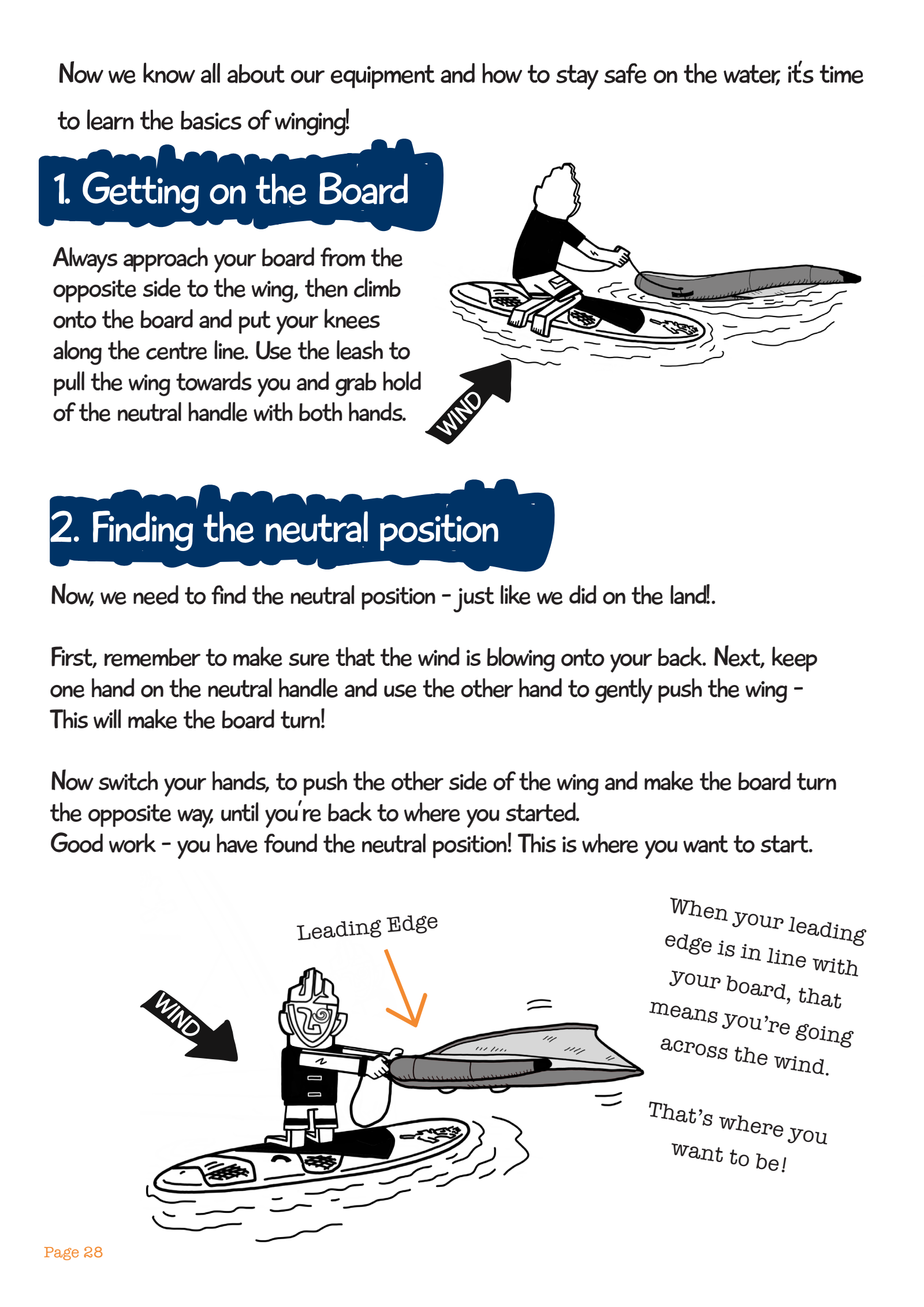
- Always approach your board from the opposite side to the wing, then climb onto the board and put your knees along the centre line. Use the leash to pull the wing towards you and grab hold of the neutral handle with both hands.
- WIND
- 2. Finding the neutral position
- Now, we need to find the neutral position - just like we did on the land!
- First, remember to make sure that the wind is blowing onto your back. Next, keep one hand on the neutral handle and use the other hand to gently push the wing - This will make the board turn!
- Now switch your hands, to push the other side of the wing and make the board turn the opposite way, until you're back to where you started. Good work - you have found the neutral position! This is where you want to start.
- Leading Edge
- WIND
- When your leading edge is in line with your board, that means you're going across the wind.
- That's where you want to be!
- Page 28
Standing up and controlling your speed
- 5. Standing up
- Now you've mastered going forwards and turning, it's time to stand up! Luckily, it's super easy. Here's how you do it...
- Aim to be near the footstraps
- Knees bent
- Wide stance
- Keeping the wing above your head, stand up with your front foot first, then your back foot. The goal is to keep your feet on the centre line.
- Don't forget to look where you're going - this will help you if you're feeling wobbly!
- 5. Controlling your speed
- On your feet, you can really begin to fly! Let's learn how to control your speed...
- TIP: Keep your grip nice and soft - you don't need to hold on super tight!
- To speed up, look over your front shoulder. This will help the wing drop down into a more powerful position.
- To slow down, use your back hand to gently let the wing move out and upwards. This will help you lose some power.
- TIP: A flappy wing is an unhappy wing! To go forwards, keep your canopy tight.
- Page 30
Learn how to come back just as much as how to go forward
Have you practiced on land holding the wing in neutral, lifting it above your head and controlling the power with your back hand? The next scene in WingKids is on the board. On the water, the board under you moves as well as the wing, so you connect the hand moves you learned on land, starting from a low, steady position.
The lesson starts in this order: getting on the board, finding the neutral position, moving across the wind and turning the board. Standing up comes only after you've learned to move forward and turn around. Remember that the lesson is built so you first learn whether you can change direction and come back, before learning to stand up fast.
Below, you'll read the lesson in four parts. Seeing a position in a picture once doesn't mean you can do it alone on the water. Go through it with an instructor who checks your gear and the wind, and use the signals you learned ahead of time whenever you need help. As the wing's power grows, it matters more to remember how to reduce the power than to hold on tighter.
Let's try it together
Put your knees down and find neutral
The picture starts with climbing onto the board from the side opposite the wing and putting your knees on the centre line. Bring the wing close, hold the neutral handle and find the position with the wind at your back. It also shows the board turning when you keep one hand on the handle and gently push the wing with the other. In a real lesson, get help from your instructor and start by feeling how the wing, the board and the wind work together.
Learn to move and reduce power while kneeling
Look at the order: take the front power handle with your front hand, lift the wing above your head, then gently hold the back handle. In this step you look where you're going, shift your front knee a little and move across the wind. You also learn to let go with your back hand to reduce the wing's power if you get too fast. Agree with your instructor on how far you'll go, and check how to stop moving too.
Turn around the other way before you stand up
To turn, start from neutral and put your front hand on the leading edge and your other hand on the neutral handle. When you move the wing toward the back of the board, the board starts to turn. As it turns, change where your knees are so you keep facing the wing. When the front of the board points the other way, find your starting position on that side. Learn by watching your instructor show the steps and checking your hand positions for yourself.
Link standing, speed and steering in order
After you've learned to move forward and turn, next comes standing up with the wing held up, front foot first and then back foot. Keep your knees bent and look where you're going. Tell the difference between lowering the wing to get power and letting it go up to lose power. Then you learn how steering works: tilt the wing back to head toward the wind, tilt it forward to head away from the wind, and bring the wing back to the middle once you're facing the way you want.
Let’s talk
What do you think?
- Why do you think the workbook teaches turning around before standing up?
- How are the moves you need when you get fast different from the moves you need to change direction?
Where the pictures and activities come from
WingKids workbook p. 28 ↗ · p. 29 ↗ · p. 30 ↗ · p. 31 ↗
The pictures are pages from the original workbook. The steps and questions below are Starboard Korea’s notes to help families use them together.
Save the original workbook ↓