
Climate and the greenhouse gas balance
A wing's product carbon footprint

Mangroves and blue carbon

Read the words in the picture
Climate and the greenhouse gas balance
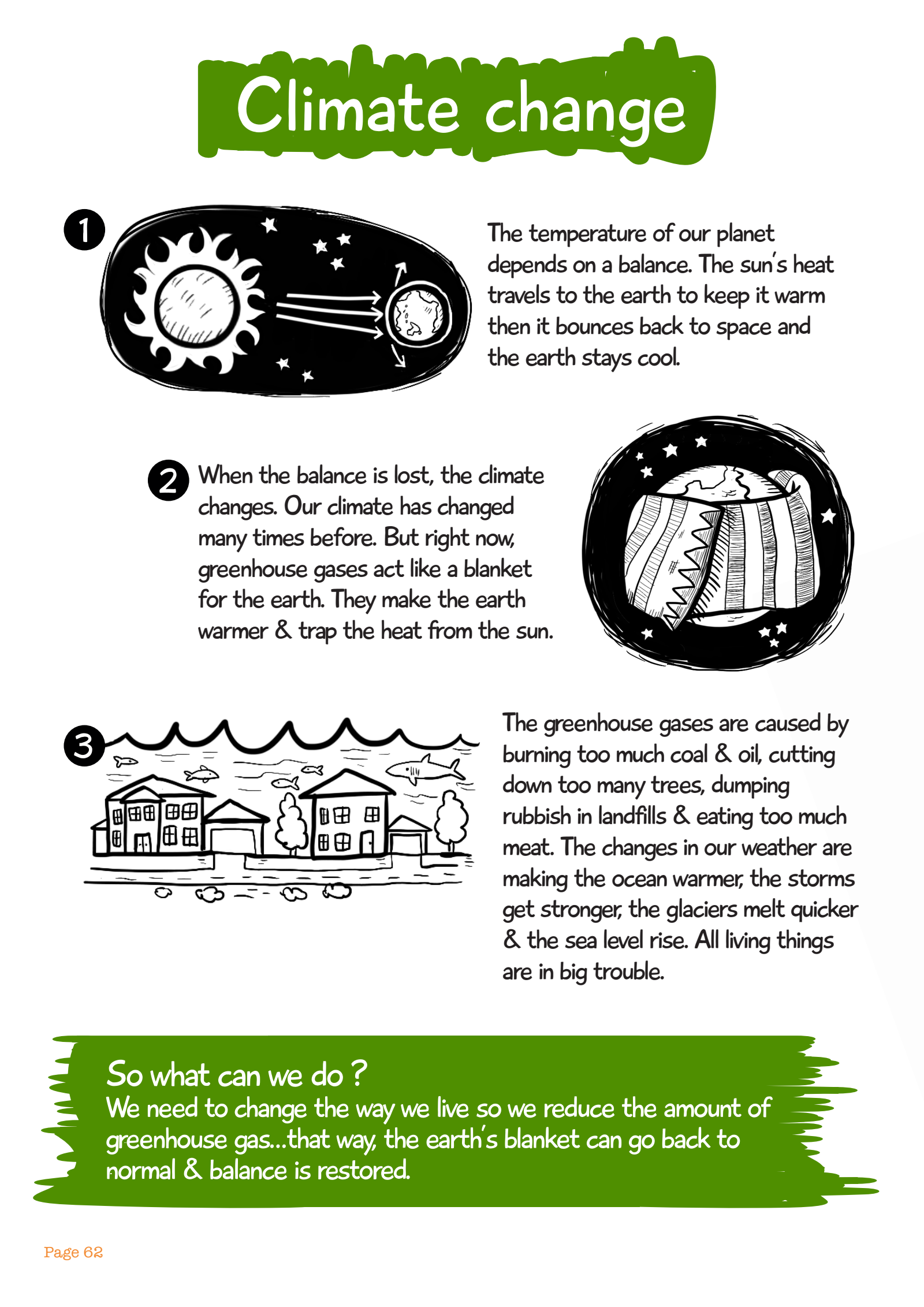
- Climate change
- The temperature of our planet depends on a balance. The sun's heat travels to the earth to keep it warm then it bounces back to space and the earth stays cool.
- When the balance is lost, the climate changes. Our climate has changed many times before. But right now, greenhouse gases act like a blanket for the earth. They make the earth warmer & trap the heat from the sun.
- The greenhouse gases are caused by burning too much coal & oil, cutting down too many trees, dumping rubbish in landfills & eating too much meat. The changes in our weather are making the ocean warmer, the storms get stronger, the glaciers melt quicker & the sea level rise. All living things are in big trouble.
- So what can we do?
- We need to change the way we live so we reduce the amount of greenhouse gas… that way, the earth's blanket can go back to normal & balance is restored.
A wing's product carbon footprint
- Your Board has a Footprint too!
- It's not just people who have carbon footprints, 'things' have them too!
- Almost anything you buy is responsible for adding some carbon dioxide into the atmosphere. Here are some of the ways that CO2 is released when making a wing:
- By the huge machines sucking oil from the ground to make plastic, or the cutting the trees to get wood.
- When electricity is used to power the factory that makes the board.
- By the trucks, planes and boats carrying materials to the factory, and then by the big cargo ships taking our boards to shops all over the world.
- When a wing reaches the end of its life and needs machines to recycle it.
- Starboard calculates the emissions released from every wing they make!
- But why?
- Measuring a wing's carbon footprint is the first step towards making it smaller.
- When we know where we are emitting carbon dioxide we can make changes to help us emit less!
- Here is an example of the carbon footprint of the Freewing LIFE Wing:
- Freewing LIFE Wing
- CO2 Emissions
- kg of CO2
- Raw Materials
- 16 kg
- Electricity
- 5.3 kg
- Shipping
- 0.5 kg
- Accessories
- 10.6 kg
- End of Life
- 2 kg
- Total: 34.4 kg of CO2
- The Freewing LIFE is the perfect wing to get you started!
Mangroves and blue carbon
- Blue carbon
- But it's not always possible to totally get rid of our carbon footprint. Even if we cut down on the amount we travel and are careful to save electricity we are still responsible for some CO2 getting into the atmosphere.
- So what else can we do to help stop climate change?
- Luckily there's a rad type of tree called a mangrove that can help! Mangroves grow in forests in between the land and the sea.
- Mangroves breathe in some of the extra carbon in the air and use it to grow branches, or store it in soil around their roots where it will stay for a very long time. So having lots of mangroves makes the earth healthier and happier.
- The more we take care of mangroves, the more carbon they can soak up!
- Here's the coolest part of this lesson: Our friends at Starboard have been planting lots of mangrove trees in a country called Myanmar - one for every wing they make!
- We wanted to help so we came up with a cool idea. Every time a WingKid school runs a program (like the one you're on right now!) we will plant a mangrove tree for each WingKid. That means there's a little mangrove seedling being planted in Myanmar with your name on it!
- Your name goes here!
Look at what happens before things reach us, and after they leave us
When you walk on the beach, you leave footprints in the sand. WingKids borrows this picture to explain a carbon footprint. It means the trail of greenhouse gases we leave when we use energy and burn fuel, in daily life and when things are made. You can't see it like a footprint, but it helps you find out where emissions come from.
A wing uses the power of the wind on the water. But you can also look at how a wing itself gets made. Getting materials, processing them in a factory, making accessories and moving things by ship or truck all need energy. And if you also look at what happens after a wing has been used for a long time, you'll see there is a long story beyond the moment you ride the wind.
The workbook uses a wing called the Freewing LIFE as an example and shows how to look at its emissions item by item. The key idea is not to put the same number on every piece of gear. It's that we need to know which steps cause emissions before we can find ways to cut them. Here, instead of memorizing numbers, try linking together what happens before and after a thing is used.
Into the story
Find the footprints that start with materials and factories
Where do the materials for making a wing come from? The workbook shows the machines that get raw materials such as plastic, and the electricity used in the factory, as the first steps. Notice that getting materials and turning them into a finished product are different stages. Even before a finished product is sitting in front of us, people and machines were at work in many places.
Follow it through shipping, accessories and the very end
While raw materials travel to the factory and finished gear travels to shops, trucks, planes and ships may be used. The workbook also looks separately at accessories and at what happens after something is used up. These are steps you can't see if you only think about the day you buy something. Think together about how used-up gear shouldn't just be thrown anywhere, and needs to be handled properly.
Read why we measure, and the choices that cut emissions
The workbook explains that measuring where emissions come from is the first step towards cutting them. For everyday life, it suggests choices like switching off lights you don't need, thinking about how you travel, and buying less while caring for what you have so it lasts longer. This doesn't mean a child has to solve every problem alone. Read it together as a family choosing one thing you can do, and also see that makers need to look at their materials and how things are made.
Connect seaside forests with caring for your things
At the end, you meet mangroves, trees that grow between the land and the sea. They are introduced as an ecosystem that soaks up carbon as it grows and also stores it in the soil around its roots. The planting activity in the workbook is one example of caring for these forests. Rather than thinking one tree can erase all emissions, read it this way: we need both efforts, cutting emissions and protecting nature.
Let’s talk
What do you think?
- Besides using a wing on the sea, which steps are connected to its carbon footprint?
- What could your family do together this time to make your gear last longer?
Where the pictures and activities come from
WingKids workbook p. 62 ↗ · p. 63 ↗ · p. 64 ↗ · p. 65 ↗
The pictures are pages from the original workbook. The steps and questions below are Starboard Korea’s notes to help families use them together.
Save the original workbook ↓