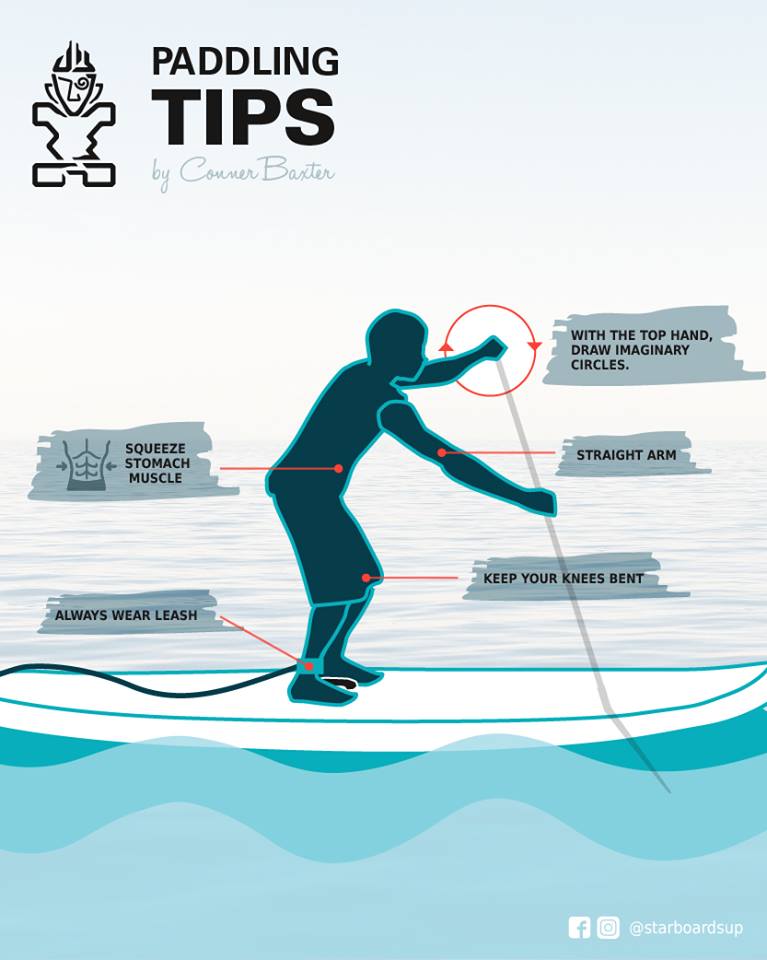

Working the paddle hard but getting tired fast? This time, instead of speeding up, let's look at which parts of your body you're using and how. The short notes in the picture show you where to look.
01. Start with your stomach and knees
The picture says to tighten your stomach and bend your knees. Rather than locking your body stiff, think about holding your stance while you respond to the board's movement.
This one picture doesn't give a common angle for how far to bend your knees. It helps to have an instructor check your stance, within a range that's comfortable for your body.
02. Watch the flow of your arms and top hand
There's a note to keep your arms straight and move your top hand as if drawing a circle. It's a way of describing Connor Baxter's motion, and it doesn't mean locking your shoulders or elbows all the way.
Look at the picture together with the forward stroke guide and link up the flow from putting the blade in to taking it out. Please don't force yourself to copy the picture in a position that hurts.
03. Observe one thing at a time
Look at one thing at a time, your knees today and where the paddle goes in next time, and it's easier to compare how it feels. Practice the basics on calm water where you can stop and come back.
The leash note in the picture should be read together with the advice below on leashes for different waters. Good form and the safety gear you need are things you prepare together.
Sources and scope
The artwork is Starboard's original infographic of Connor Baxter's five form notes; the explanation is Starboard Korea's commentary. The circular hand movement is a movement cue from the original, not an instruction to lock your joints or a common stance angle. For leashes, we link to advice for different waters.
The illustration is Starboard's original artwork; the explanation is Starboard Korea's editorial guide, translated into English here. Sources checked: 2026-09-08.