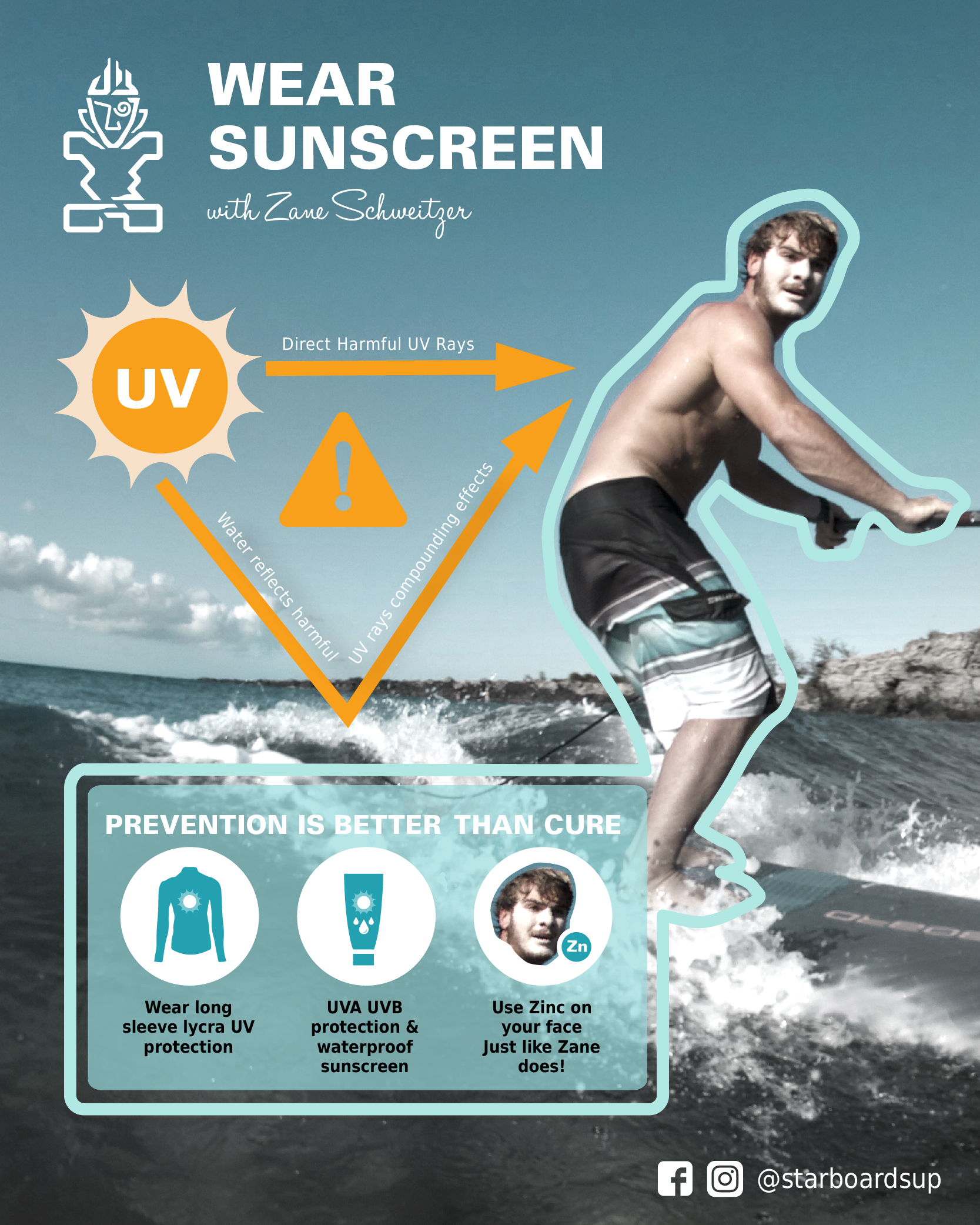

When a cool breeze is blowing, the sun can feel weak. But on the water, shade is hard to find and your skin can easily be exposed for a long time. Add sun protection to your prep before you head out.
01. Shall we follow the arrows in the picture?
The arrows coming down show UV reaching your skin directly, and the arrows coming up from the water show reflected UV. It's hard to judge how much you're exposed just by how cool it feels.
Getting ready is easier if you think about putting on sunscreen and covering your skin together. The long-sleeve rash guard in the picture is one way to do that.
02. Read the label, not just the front of the product
The American Academy of Dermatology advises broad-spectrum protection against both UVA and UVB, SPF 30 or higher, and water resistance. Since you'll be using it on the water, check the directions and the water-resistance labeling on the package too.
The picture also shows an example of an athlete who uses zinc oxide. Rather than taking it to mean you must use one particular ingredient, focus on using enough of a product that suits your skin.
03. One application doesn't cover the whole day
Apply before you go outside, and reapply about every two hours outdoors. The American Academy of Dermatology advises reapplying right after swimming or sweating. Follow the product label too.
Check easy-to-miss spots like your neck, ears and the tops of your feet. When you take a break in the shade after coming off the water, drink some water and check your protection again; that makes getting ready for your next ride easier.
Sources and scope
The artwork is Starboard's original Zane Schweitzer sunscreen infographic; the explanation is Starboard Korea's commentary. Our commentary reads the artwork's word "waterproof" as water-resistant rather than fully waterproof, so as not to overstate it. The SPF and reapplication advice was added from American Academy of Dermatology guidance.
- Starboard HQ infographic: Wear Sunscreen-03.jpg ↗
- American Academy of Dermatology: how to use sunscreen ↗
The illustration is Starboard's original artwork; the explanation is Starboard Korea's editorial guide, translated into English here. Sources checked: 2026-09-08.