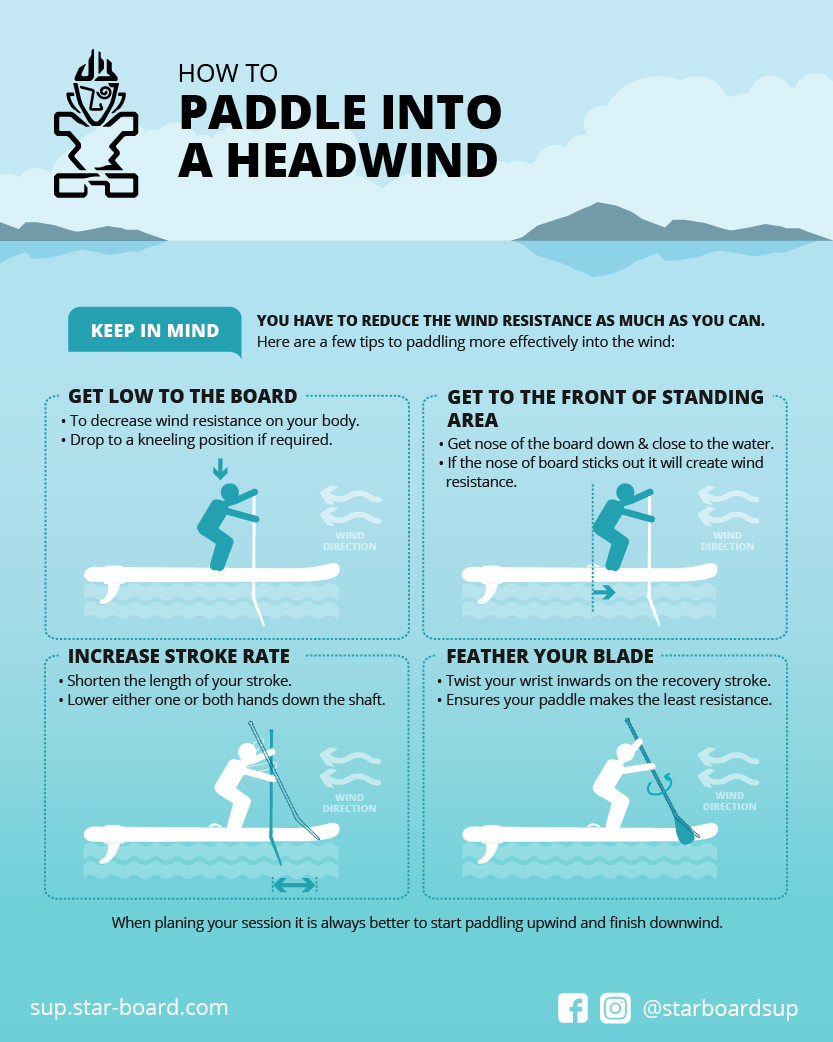

The picture explains techniques for reducing headwind resistance. Avoid wind blowing from the shore out to sea, and check the forecast, currents and your way back before you set out.
Paddling that felt easy on the way out can get unusually hard on the way back. That may be down to a headwind blowing in your face. The picture introduces techniques for reducing resistance, but that doesn't mean it's OK to go out on windy days.
01. Check the wind direction before any technique
Avoid wind blowing from the shore out to sea. Even if the water looks calm, the board can be pushed out, and you'll have to paddle against that same wind to get back.
Before you go, check the forecast along with the wind on site, the currents and your way back. The original's “start into the wind, finish with the wind behind you” is a hint for planning your route, not a guarantee that the wind and currents will stay the same. If it's hard to judge, put off going out and get local advice.
02. Reduce resistance from your body and the front of the board
The first move in the picture is getting lower. It explains kneeling if needed to reduce how much of your body catches the wind.
The second is moving slightly forward within your standing area so the nose doesn't lift high. It doesn't mean walking to the tip of the nose or pushing it into the waves. Check how far you can go while keeping your balance on your own board and in the water conditions.
03. Look at short strokes and the blade angle
The original introduces shortening your stroke and moving your hand lower on the shaft to paddle continuously. The idea is to keep a flow going with short strokes rather than putting power into each big stroke.
It also explains feathering: when bringing the paddle forward out of the water, you turn the blade so its wide face doesn't catch the wind head-on. Don't bend or tense your wrist too much, and it's good to learn this first in familiar conditions.
04. If you're being pushed back or getting tired, ask for help early
If you keep getting pushed back or lose confidence that you can make it back even with these techniques, don't hold on until you're exhausted. If you feel in danger, stay with your board, alert people around you and call for help with a waterproof way to call that you carry on you.
Deciding to hold off on going out is good riding preparation too. Rather than aiming to beat the wind, start by making a habit of choosing conditions where you can get back comfortably.
Sources and scope
The artwork is Starboard's original Paddle Against the Wind infographic with its four resistance-reducing moves; the explanation is Starboard Korea's commentary. Starboard's article classifies this as an intermediate technique. We do not generalize the original's planning line into a launch rule for every body of water, and we added RNLI guidance as editorial commentary: avoiding wind blowing from the shore out to sea, checking forecasts and currents, staying with your board and calling for help. We do not give any personal safe wind speed.
- Paddle against the wind_v1-01.jpg ↗
- Starboard: paddling into the wind ↗
- RNLI SUP safety advice ↗
- RNLI: staying with your board and calling for help if you drift ↗
The illustration is Starboard's original artwork; the explanation is Starboard Korea's editorial guide, translated into English here. Sources checked: 2026-09-08.