
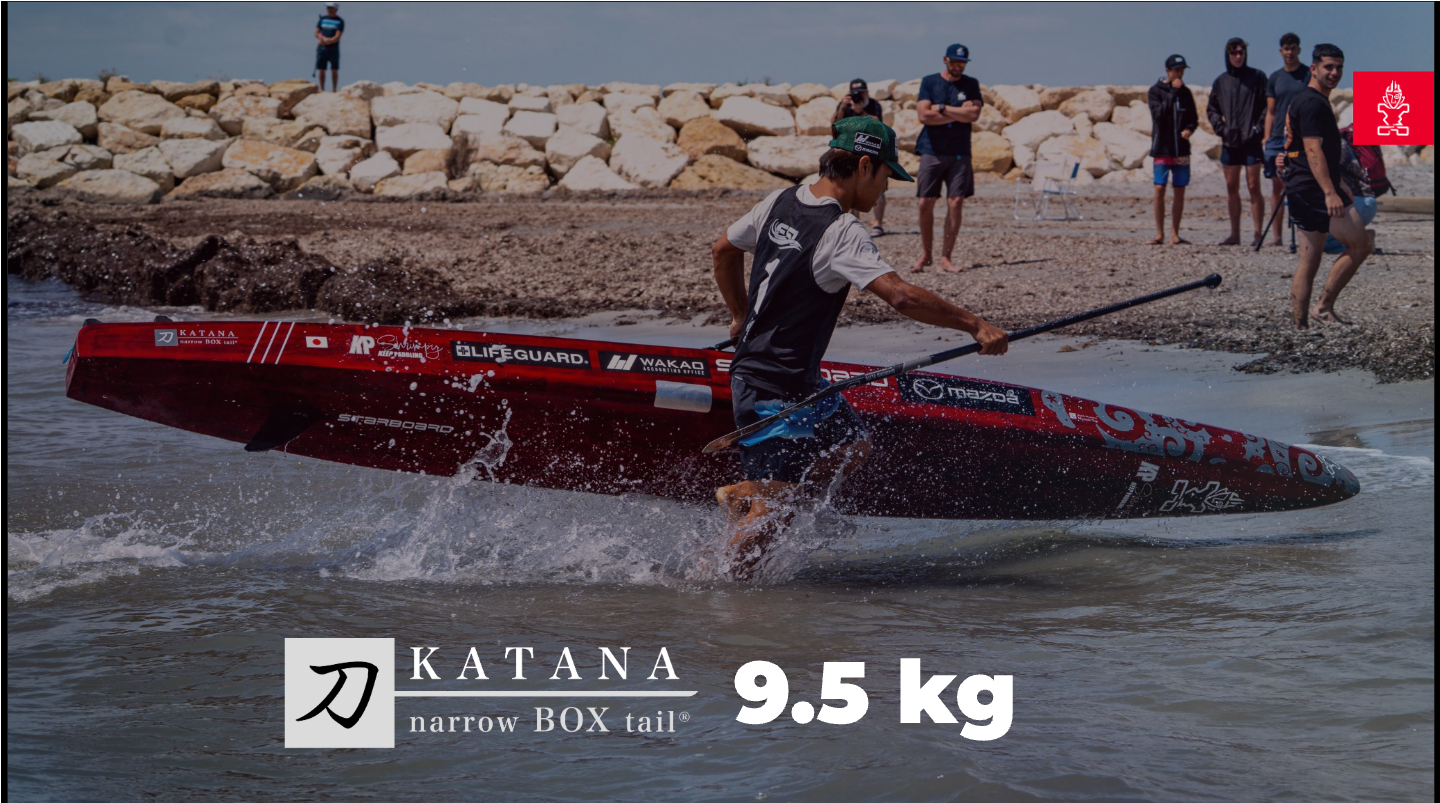
The KATANA makes a light first impression. On the water, what matters next is how it responds underfoot. During Michael Booth’s first paddle in Japan, stability, stroke rhythm, glide between bumps and turning became the focus.
The KATANA is Shuri Araki’s signature race board, developed with his father and coach Takuji Araki. Booth’s first impressions offer a rider’s perspective alongside the board’s design.
The 9.5kg image and the board Booth paddled
The image highlights the KATANA’s light weight with a 9.5kg label. It does not specify weighing conditions or the sizes and constructions covered, so that figure is not presented here as a confirmed weight for every Korean retail board.
Booth said he was told the non-production board he paddled weighed 9.8kg. He expected a KATANA using D2 technology to be about 10.2kg. The image’s 9.5kg label, the test board’s reported 9.8kg and the roughly 10.2kg D2 estimate come from different contexts.
He also mentioned a D2 TSURUGI at 10.2kg and a D2 ALL STAR at 10.4kg, compared with the roughly 11.6kg ALL STAR he used at the Worlds. He welcomed the lower weights of non-hollow hard boards. These were individual boards he discussed, not a controlled comparison of matching sizes and configurations.
9.5kg = supplied image label · 9.8kg = reported non-production test-board weight · about 10.2kg = Booth’s D2 estimate
A first session in 10–12 knots and small swells
The session took place in 10–12 knots of side-offshore wind with small rolling swells. Side-offshore wind blows diagonally away from shore. Booth covered about 7km with a clinic group and pushed harder a couple of times.
This was an introduction to the board in wind and small swells, rather than a flat-water top-speed test.
Sharp rails, then stability after adjusting his stance
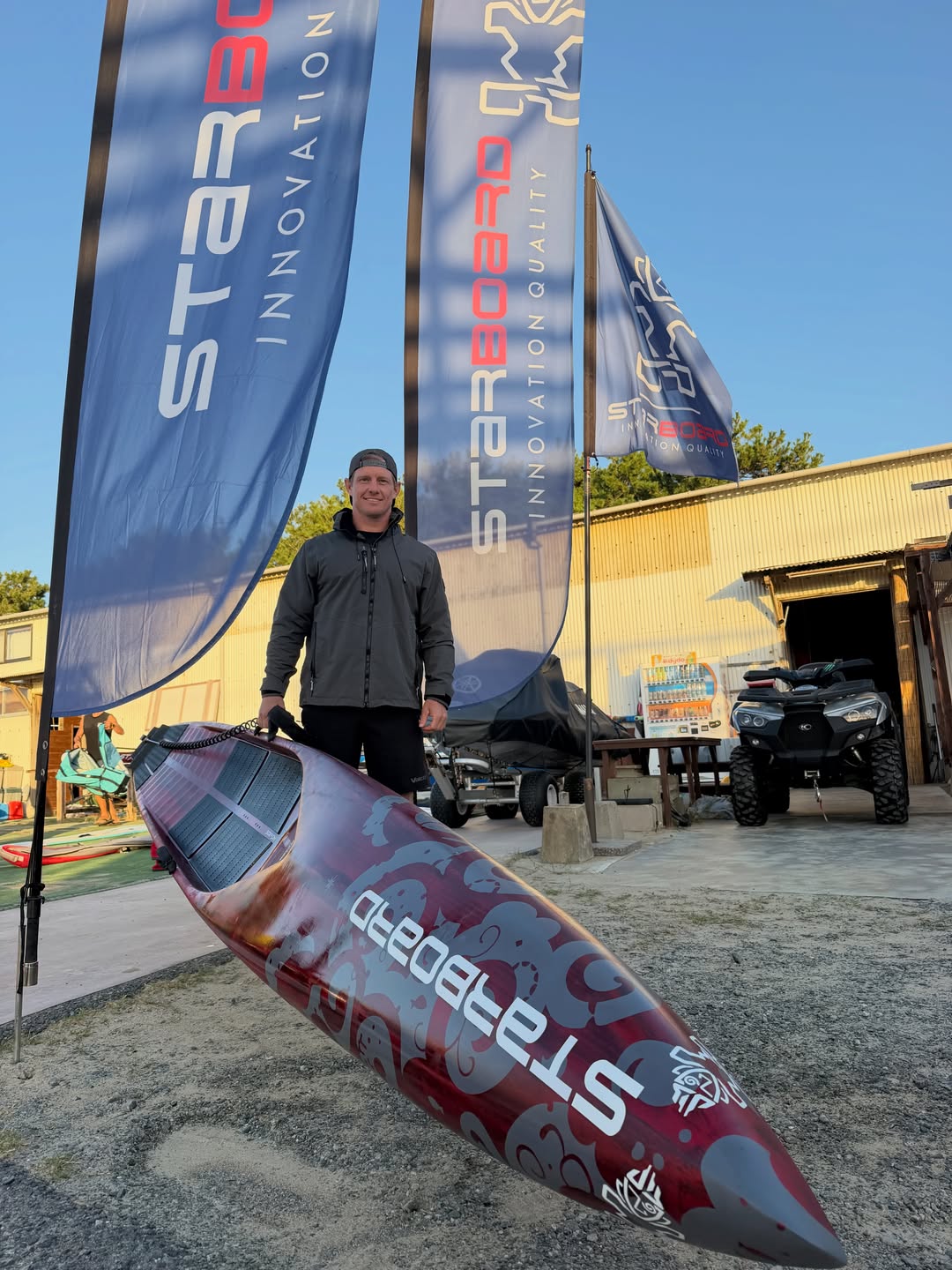
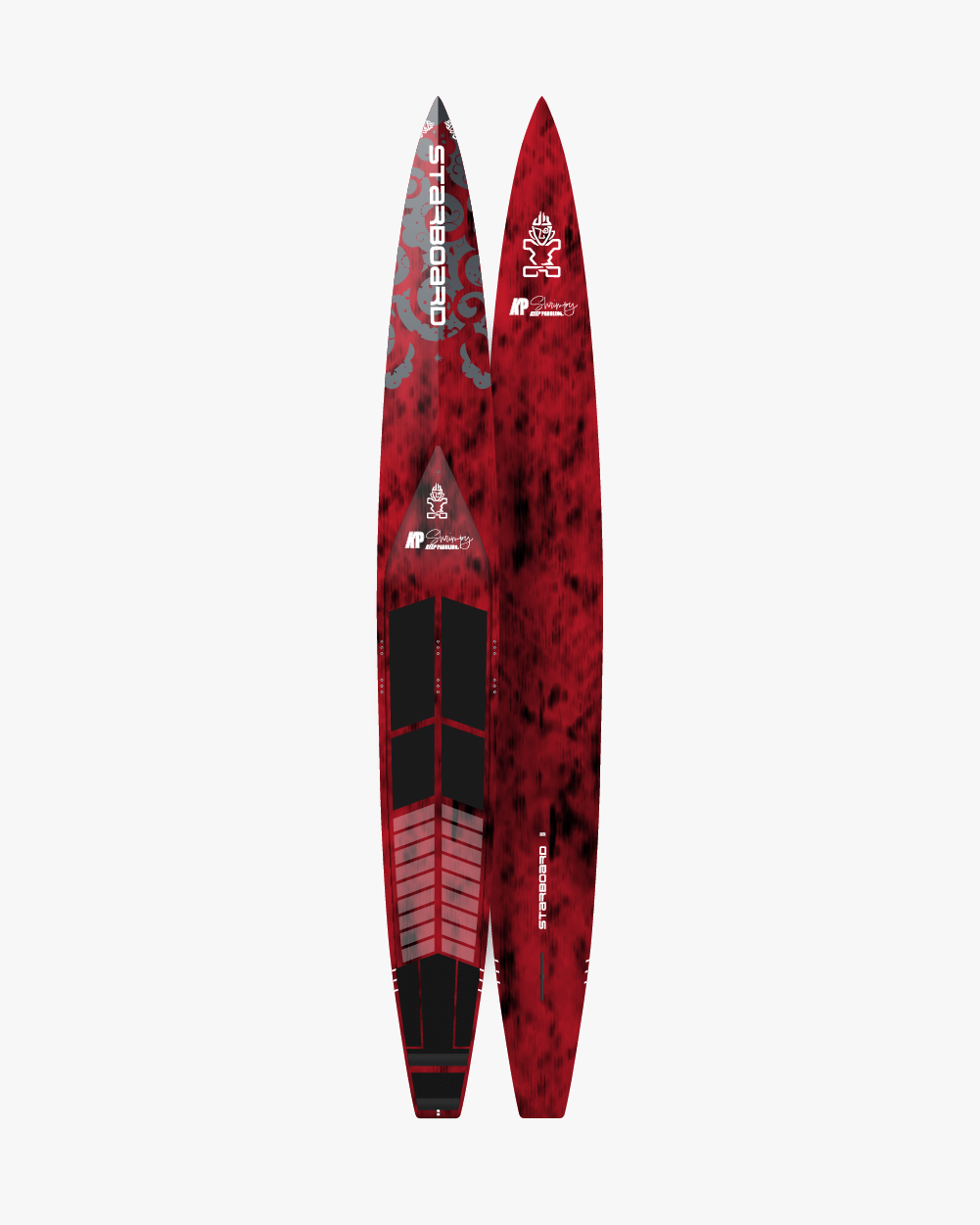
Compared with the ALL STAR he knew, Booth saw less rocker, a boxier tail and more evenly distributed volume. Rocker is the board’s lengthwise curve. The sharp rails initially looked less forgiving, but after adjusting his stance he found a flat, stable feel.
The KATANA combines a narrow Box Tail™, a rearward standing position and a dugout deck. Sharp tail rails support tracking, while the lowered standing area brings the centre of gravity down. Booth’s experience illustrates how stance can change the feel of the same board.
The stroke rhythm that felt comfortable to Booth
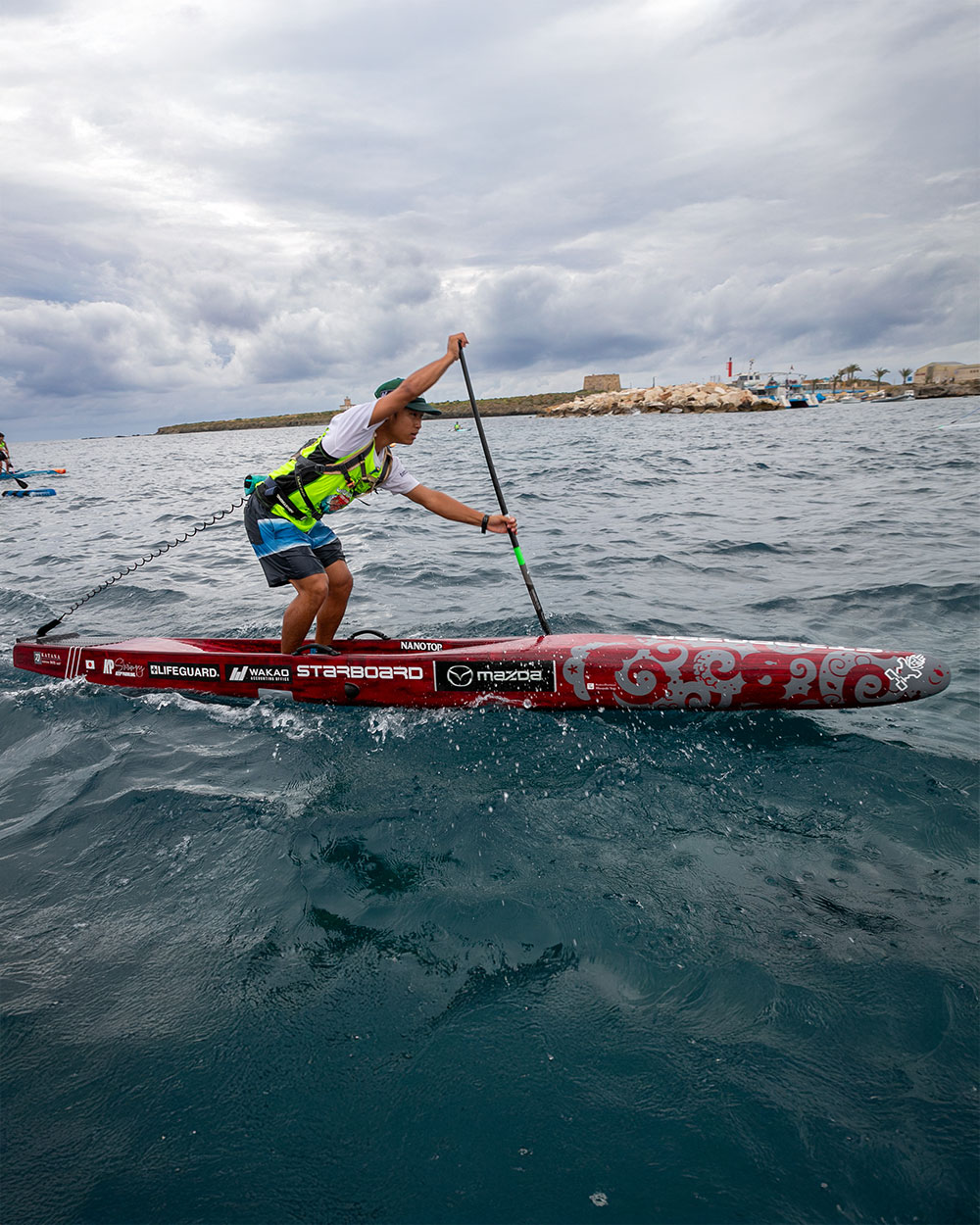
Booth felt the board suited a front-end stroke, similar to his experience on newer SPRINT models. It felt less forgiving when he paddled past his feet, but during this session he found a solid rhythm without needing a very high cadence. In a reply, he clarified that he meant his normal stroke rate.
That was Booth’s personal response during his first session. It does not turn the KATANA’s design around fast, precise paddling rhythm into a recommendation that every rider should paddle slowly.
Glide and acceleration between bumps
Booth liked how the board caught bumps, glided, steered on its rails and accelerated. Asked about acceleration relative to the ALL STAR, he said it did not feel very different, while making clear that he had not done a direct comparison.
Enjoying a board’s acceleration is different from demonstrating that it is faster than another model. This first impression describes how the KATANA responded, rather than ranking it by measured speed.
Learning the tail through turns
The boxier tail and extra rear volume felt like a ramp when Booth stepped back to turn. It took some adjustment to find his foot position, and the sensation reminded him of the 2022 ALL STAR. He felt newer ALL STAR models might be a little easier to turn.
His first impression was positive: light weight, stability after adjusting his stance and the ability to link bumps stood out. Turning and stroke technique still called for time to learn the board. Booth planned further paddles when he posted; this story covers that first session.
Explore the KATANA available in Korea
The current Korean product page lists a 14′0″ × 20.5″, 270L KATANA in CRS D2 at KRW 8,000,000. Numbers in Booth’s test-board replies are not substituted for the retail specification. Visit the product page for the available purchase option.