
Muscles for SUP and the seaweed game
Four yoga poses for SUP

Read the words in the picture
Muscles for SUP and the seaweed game
- Lesson Four · healthy SUPKids
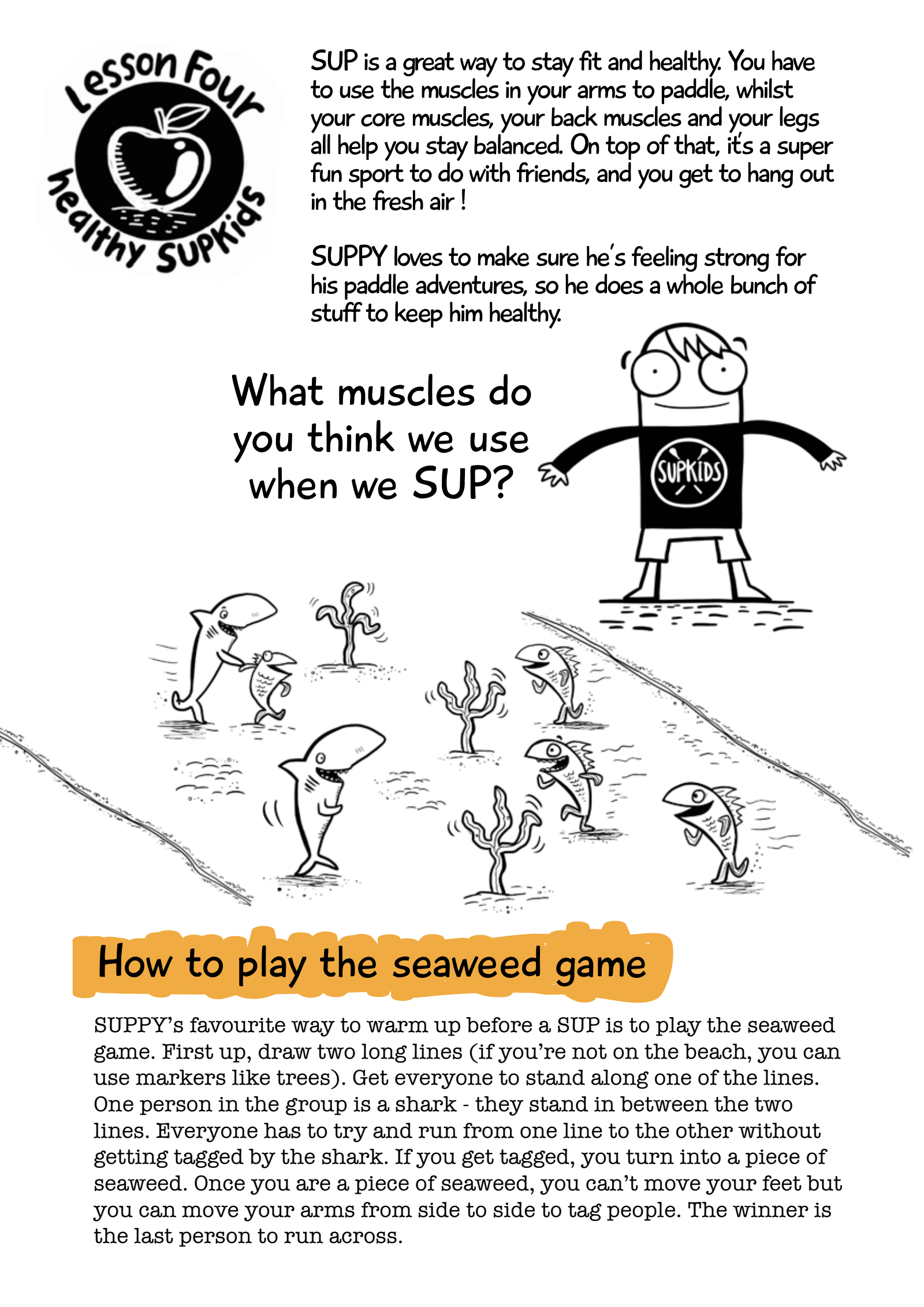
- SUP is a great way to stay fit and healthy. You have to use the muscles in your arms to paddle, whilst your core muscles, your back muscles and your legs all help you stay balanced. On top of that, it's a super fun sport to do with friends, and you get to hang out in the fresh air!
- SUPPY loves to make sure he's feeling strong for his paddle adventures, so he does a whole bunch of stuff to keep him healthy.
- What muscles do you think we use when we SUP?
- How to play the seaweed game
- SUPPY's favourite way to warm up before a SUP is to play the seaweed game. First up, draw two long lines (if you're not on the beach, you can use markers like trees). Get everyone to stand along one of the lines. One person in the group is a shark - they stand in between the two lines. Everyone has to try and run from one line to the other without getting tagged by the shark. If you get tagged, you turn into a piece of seaweed. Once you are a piece of seaweed, you can't move your feet but you can move your arms from side to side to tag people. The winner is the last person to run across.
Four yoga poses for SUP
- Yoga
- Yoga is an awesome way to stay fit & flexible for SUP. It helps us with our strength, balance & focus. When you are practising yoga, remember to breathe in and out slowly through your nose.
- Mountain
- Stand tall & straight with your feet together. Put your hands together in front of your chest. Hold for 10 deep breaths. Go further - Try closing your eyes
- Tree
- Stand tall and lift one foot and rest it on the inside of the other ankle. Lift your arms over your head and hold for 5 breaths. Then try the other side. Go further - Lift the foot higher so it rests above your knee!
- Eagle
- Bend both knees, then lift one leg and cross it over the other. You can touch your toes on the floor or try to balance on one leg. Hold for 5 breaths and then try the other side. Go further - Hold your arms out to your sides, then bring them in front of you and cross one elbow over the other.
- Chair
- Bend both knees and sit down into an invisible chair. Lift your arms up and point them towards the sky. Hold for 5 breaths. Go further - Go lower & see how long you can hold the pose for!
Before you ride a board, feel how your body moves
When you ride a SUP, do only your arms do the work? SUPKids says you use your arms to move the paddle. You also use your core, back and legs to help you balance. Think about what your body does when the board wobbles a little. Then you can see how a warm-up before you go in the water connects to SUP.
SUPPY's favorite warm-up game is the seaweed tag game. In the original workbook, the running game with friends comes first. Next comes circuit training, where you take turns doing different exercises. Then come yoga poses shaped like a mountain, a tree, an eagle and a chair. You get to try different kinds of movement: running, stopping, holding your body up and feeling your balance.
The goal of this activity is not to finish every count and every hold time in the pictures. Choose a safe spot with a grown-up and find movements that feel comfortable for your body. If a friend sits lower or holds a pose longer, you don't have to force your body into the same shape. Talking about how your body feels and taking a rest are part of the activity too.
Try it together
Set the roles and boundaries for the seaweed game
The seaweed game has a starting line, a line on the other side and a shark who is 'it' between the two lines. Everyone else crosses to the other side. If the shark tags you, you turn into seaweed. Seaweed can't move their feet, but they can move their arms to tag friends who pass by. Before you start, check the space with a grown-up. Agree on a way to tag without pushing or grabbing hard. If there aren't many people, you can read the rules and draw the roles instead.
Find the six circuit training moves
The workbook also shows push ups, tricep dips with your hands on a bench, squats, the superman, the plank and the V-sit. Read each name and ask a grown-up what the move looks like. Think about which moves use your hands for support and which use your legs. Choose the moves you will actually try with a grown-up or coach, and check that the floor and any support are steady. Instead of repeating hard moves on your own, start with movements you already know.
Feel your balance like a mountain and a tree
The mountain pose picture shows standing tall with your hands together in front of your chest. The tree pose starts with one foot resting lightly on the inside of the other ankle while you feel your balance. The chair pose looks like bending your knees to sit in an invisible chair. You don't need to try the harder versions in the pictures. Keep your eyes relaxed and move in a range that feels steady.
Finish by talking about your breath and your body
When you do yoga, remember to breathe in and out slowly. After moving, tell a grown-up which parts of your body worked hard and whether any part wants a rest. Remember to rest and have a drink between circuit exercises, too. Pick one move that felt comfortable today, and say why you'd like to do it again at your next warm-up.
Let’s talk
What do you think?
- Which parts of your body do you use to paddle, and which parts help you balance on the board?
- Which movement felt comfortable for your body today? Which movement would you like some help with?
Where the pictures and activities come from
SUPKids workbook p. 32 ↗ · p. 33 ↗ · p. 34 ↗ · p. 35 ↗
The pictures are pages from the original workbook. The steps and questions below are Starboard Korea’s notes to help families use them together.
Save the original workbook ↓