
Waves & ocean · Beginner
Reading waves for SUP surfing
Find the peak, pocket and shoulder in the field guide, then use them to read a wave and choose a longboard SUP takeoff spot.
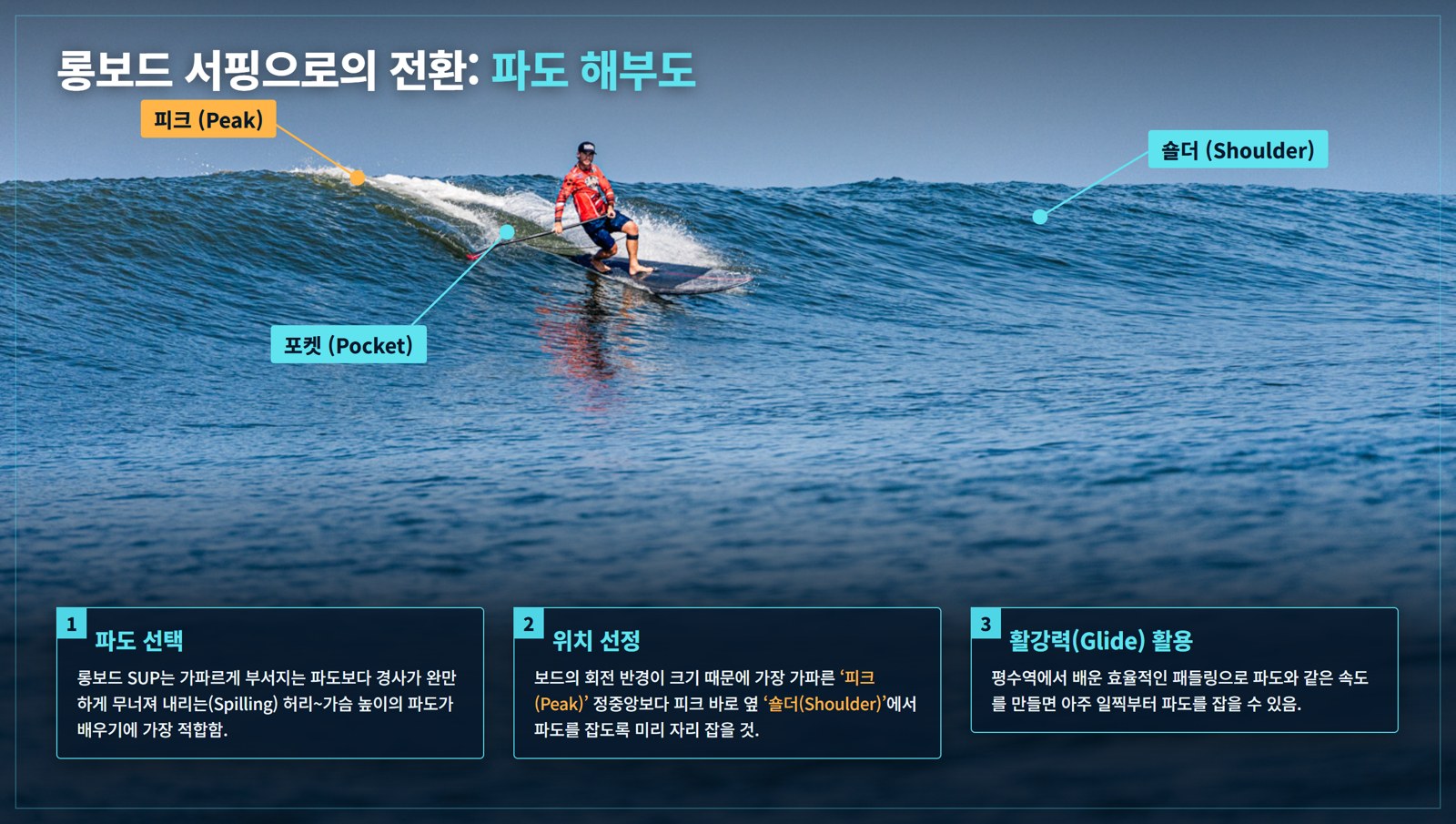
Watch a few sets from the beach. Find where each wave starts to break, which side stays open and where the riders already on it are going. Those clues help you choose which wave to catch and which to let pass.
01. From the peak to the open shoulder
The peak is where the wave first breaks. Look for the crest rising and starting to foam, as shown by the yellow marker on the left.
The pocket is the powerful part beside the breaking edge, marked just behind the rider. Staying close to it gives the board more push and calls for timing that matches the break.
The shoulder is the gentler face running away from the pocket. The clean section on the right shows where the board can continue.
The face is the unbroken surface the board rides. Whitewater is the foamy water that has already broken. From the beach, see how long an open face stays beside the foam.
02. Watch how the wave breaks
A spilling wave breaks gradually as foam tumbles down its face. A plunging wave throws its lip forward and breaks quickly and forcefully. Let a closeout pass when a long section breaks almost at once and the open face disappears.
For a first session, practise timing on a small, gentle wave chosen by your instructor. Check water depth, currents and room around other people even when the waves look small.
03. Read the shoulder for a takeoff spot
On a gentle wave, look for a shoulder that stays open beside the peak. Let the wave go if someone is already riding it or taking off closer to the peak.
With a clear line ahead, paddle to build speed before the wave starts pushing the board. A longboard SUP's glide helps carry that speed. Notice when you feel the wave take over and where the open face leads.
04. Check the flow through quieter patches
A gap between breaking waves can carry a rip current, a flow moving away from the beach. Foam moving steadily offshore can be a clue, and some rip currents are hard to spot.
At an unfamiliar beach, ask the lifeguard or an instructor where to enter, what to avoid and how to return.